
The Illusion of Precision
Civil litigation likes to present itself as a system of precision. Judges assign percentages. Juries weigh fault. Experts debate causation down to the decimal point. On paper, it looks like a clean exercise in dividing responsibility. From my mediator’s seat, it is anything but in practice.
Apportionment is not a science. It is a legal construct layered over messy human events. Accidents rarely unfold in neat, isolated acts. They are chains of conduct, omissions, and reactions, often involving multiple actors whose decisions intersect in ways that are only fully understood in hindsight. The law responds to that complexity with a blunt but necessary tool, namely joint and several liability.
The result is a system where responsibility may be divided in theory, but recovery is not.
The Legal Framework: Fault Can Be Split, Liability Cannot
In Ontario, apportionment of fault is governed by the Negligence Act[1]. The statute directs courts to assess degrees of fault among negligent parties. It recognizes that multiple actors can contribute to a single loss and provides the mechanism to assign relative responsibility. As s. 1 provides,
“where damages have been caused or contributed to by the fault or neglect of two or more persons, the court shall determine the degree in which each of such persons is at fault or negligent.”
But the statute does not stop there. It preserves joint and several liability and where two or more persons are found at fault, they are jointly and severally liable to the person suffering the loss or damage. That means a plaintiff can recover 100 percent of their damages from any one defendant found even minimally at fault, leaving that defendant to pursue contribution from others. Section 1 further provides,
“as between themselves, in the absence of any contract, express or implied, each is liable to make contribution and indemnify each other in the degree in which they are respectively found to be at fault or negligent,”
This dual structure of apportionment of fault combined with joint and several liability creates the central tension that drives multi-party litigation. Fault is divided. Financial exposure is not.
Causation Before Apportionment
Before fault is ever apportioned, causation must be established. That threshold question of what caused the loss remains the gatekeeper.
The modern framework is set out in Clements v. Clements[2], where the Supreme Court of Canada in 2012 reaffirmed the “but for” test as the primary standard for causation. The case arose from a motorcycle accident in which the plaintiff, riding as a passenger, suffered a catastrophic brain injury after the bike, overloaded and travelling at excessive speed, lost control following a sudden tire deflation. Although the defendant driver’s negligence was not in dispute, the trial judge concluded that the plaintiff could not establish causation on a strict “but for” basis due to the limits of scientific reconstruction evidence, and instead imposed liability using a material contribution analysis. The Supreme Court rejected that approach. It held that causation does not require scientific precision and must be assessed using a “robust and pragmatic” common-sense inference drawn from the evidence as a whole. The Court emphasized that the “but for” test remains the default rule, and that the material contribution approach is a narrow, exceptional doctrine, available only where it is truly impossible to prove causation using the but-for test and multiple negligent defendants are involved. On the facts before it, namely a single-defendant case, the Court found that the trial judge had erred in both demanding scientific proof and resorting to the material contribution test, and ordered a new trial on the proper “but for” framework.
What matters here is not just the legal test, but its practical consequence. Once a defendant crosses the causation threshold, they are in the pool. From that point forward, the debate shifts from “whether” they are responsible to “how much.”
And even that question, as it turns out, has limits.
The Anatomy of Apportionment
Apportionment is inherently comparative. Courts assess relative blameworthiness, not mathematical causation. The exercise is less about scientific precision and more about moral and practical judgment.
The leading authority remains the 1996 decision in Athey v. Leonati[3], where the Supreme Court addressed a plaintiff who suffered a disc herniation following two motor vehicle accidents, against a backdrop of pre-existing back problems. The trial judge had found that the accidents were only a partial cause, assigning them 25 percent responsibility, and reduced the damages accordingly. The Supreme Court rejected that approach outright. It held that once a defendant’s negligence is proven to have caused or contributed to an indivisible injury, liability is complete, not divisible. The presence of non-tortious contributing factors, such as a pre-existing condition, does not reduce the defendant’s responsibility. The Court emphasized that causation is a threshold question: once it is established on a balance of probabilities that the defendant’s negligence was a cause of the injury, the law treats that causal link as certain, not proportionate. The reasoning reflects the thin skull principle in its clearest form, that the defendant must take the plaintiff as they are found, and draws a firm line against apportioning damages between tortious and non-tortious causes where the injury is indivisible.
This is where apportionment becomes a secondary exercise. It matters as between defendants. It does not limit the plaintiff’s right to full recovery.
The Court returned to similar themes in Blackwater v. Plint[4], confirming that where harm is indivisible, liability remains joint and several, even if fault is apportioned. The case arose out of systemic sexual abuse at a residential school jointly operated by the federal government and the United Church, where both entities were found vicariously liable for the acts of a dormitory supervisor. Although the trial judge apportioned responsibility unequally (75 percent to Canada and 25 percent to the Church), the Supreme Court made clear that this division operated only as between the defendants. From the plaintiff’s perspective, the liability remained whole. The Court emphasized that joint and several liability ensures full compensation, while apportionment serves a secondary function of allocating responsibility between wrongdoers based on their relative degree of control and ability to prevent the harm. In doing so, the Court rejected the notion that unequal fault diminishes exposure to the plaintiff, and reaffirmed that where multiple tortfeasors are each found to have caused or contributed to a single, indivisible injury for the entire loss, subject only to rights of contribution between them.
The principle is straightforward. The injury is one. The responsibility may be shared. The exposure remains whole.
Indivisible Harm and the Collapse of Percentages
The distinction between divisible and indivisible harm is where apportionment either holds or collapses.
Where harm can be separated, for example distinct injuries attributable to different events, courts may assign discrete responsibility. But in most personal injury cases, particularly those involving chronic pain, psychological overlay, or cascading physical conditions, the harm is treated as indivisible. Once that finding is made, percentages of fault do not translate into percentages of liability as against the plaintiff. They become relevant only for contribution claims between defendants.
This is not a technical nuance. It is the defining feature of the system.
Joint and Several Liability: Policy Over Precision
Joint and several liability is not an accident. It is a deliberate policy choice.
The law places the risk of an insolvent or unavailable defendant on the remaining wrongdoers, not on the injured plaintiff. It reflects a basic prioritization: compensation over fairness among defendants.
That policy has been repeatedly affirmed. As the Supreme Court made clear in Athey v. Leonati and later reinforced in Blackwater v. Plint, the law prioritizes full compensation for the plaintiff, even where doing so produces harsh or disproportionate outcomes as between defendants.
From a defendant’s perspective, this can feel fundamentally unfair. A party found 10 percent at fault may end up paying 100 percent of the judgment. From the plaintiff’s perspective, it is the only way to ensure full recovery in a world where not all defendants are solvent, insured, or even identifiable.
The system chooses certainty of recovery over symmetry of blame.
Strategic Blame: Litigation in the Shadow of Exposure
Once joint and several liability is understood, litigation strategy begins to make sense.
Defendants do not simply defend against the plaintiff’s claim. They defend against each other. Every percentage point of fault shifted to a co-defendant is a reduction in contribution exposure, even if it does nothing to reduce liability to the plaintiff.
This dynamic drives third-party claims, crossclaims, and the constant effort to broaden the field of blame. The goal is not necessarily to escape liability altogether. It is to dilute it.
The result is a form of strategic blame allocation that can overshadow the underlying dispute. Litigation becomes less about what happened and more about who else can be brought into the frame.
The Empty Chair Problem
There is, however, a limit. Fault cannot be formally apportioned under the Negligence Act to a non-party. This creates what is often referred to as the “empty chair” problem. If a potentially responsible party is not before the court because they were not sued, cannot be found, or are insolvent, remaining defendants cannot assign them a share of fault for the purpose of reducing their own liability to the plaintiff.
The practical consequence is stark. Defendants must actively identify and bring in other responsible parties. Failure to do so can leave them carrying the entire judgment, regardless of the broader factual landscape.
Settlement Pressure and the Weight of Uncertainty
All of this converges on one, unavoidable reality that joint and several liability creates settlement pressure.
A defendant facing even modest exposure on paper must confront the risk of catastrophic liability in practice. That risk is magnified by uncertainty in apportionment, in credibility findings, in expert evidence, and in jury reaction.
The system does not reward optimism. It punishes miscalculation.
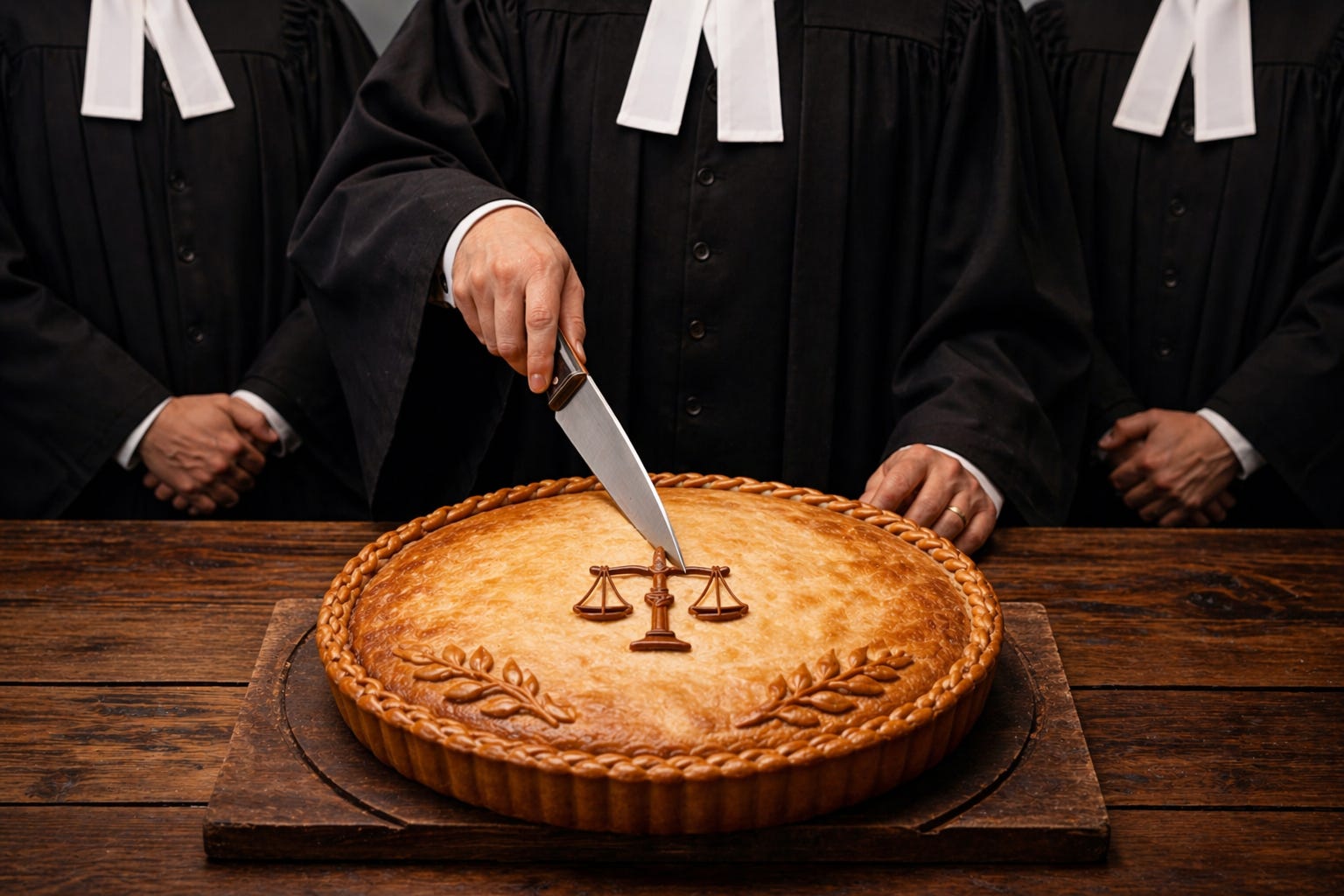
This is why cases that appear defensible in isolation often settle at values that reflect systemic risk rather than strict legal merit. The law of apportionment may suggest a narrow slice of responsibility. Joint and several liability expands that slice into a full pie.
The Mediation Lens: Where Theory Meets Reality
This is where mediation becomes not just useful, but essential.
In the mediation room, the legal framework does not disappear. It sharpens. Parties arrive with their percentages, their theories of causation, and their carefully constructed narratives of blame. But they also arrive with something more important: risk.
Joint and several liability changes the conversation. It forces defendants to confront exposure that cannot be neatly contained by apportionment arguments. It forces plaintiffs to assess collectability, insurance limits, and the practical realities of enforcement. It brings into focus the difference between winning on paper and recovering in fact.
The most productive mediations in multi-party cases are those where this dynamic is acknowledged early and addressed directly. Blame is still debated, but it is not allowed to dominate. The discussion shifts to allocation of risk, contribution frameworks, and structured resolutions that reflect both legal principles and practical constraints. I wrote about multi-party mediations in a slip and fall context in my Substack article last year, “When Liability is a Moving Target: Mediating Multi-Party Slip-and-Fall Claims” [5].
In that setting, mediation does what litigation often cannot. It allows parties to divide the pie in a way that is informed by the law, but not imprisoned by it. In multi-party cases, the real negotiation is rarely about liability. It is about who is left carrying the shortfall.
Closing Reflection
Apportionment promises fairness. Joint and several liability delivers certainty. The two are not always aligned.
The system accepts that tension because it has to. From my seat, perfect allocation of fault is an illusion. Ensuring that an injured plaintiff is made whole is not.
For those navigating multi-party disputes, the lesson is clear. Do not confuse percentages with exposure. Do not assume that a small share of blame carries a small risk. And above all, do not underestimate how quickly the conversation shifts once the full weight of joint and several liability is brought into view.
In the end, dividing the pie is not about precision. It is about who is left holding the knife.
[1] https://www.ontario.ca/laws/statute/90n01
[2] 2012 SCC 32, [2012] 2 S.C.R. 181. Online: https://www.canlii.org/en/ca/scc/doc/2012/2012scc32/2012scc32.html
[3] [1996] 3 S.C.R. 458. Online: https://www.canlii.org/en/ca/scc/doc/1996/1996canlii183/1996canlii183.html
[4] [2005] 3 S.C.R. 3, 2005 SCC 58. Online: https://www.canlii.org/en/ca/scc/doc/2005/2005scc58/2005scc58.html
