
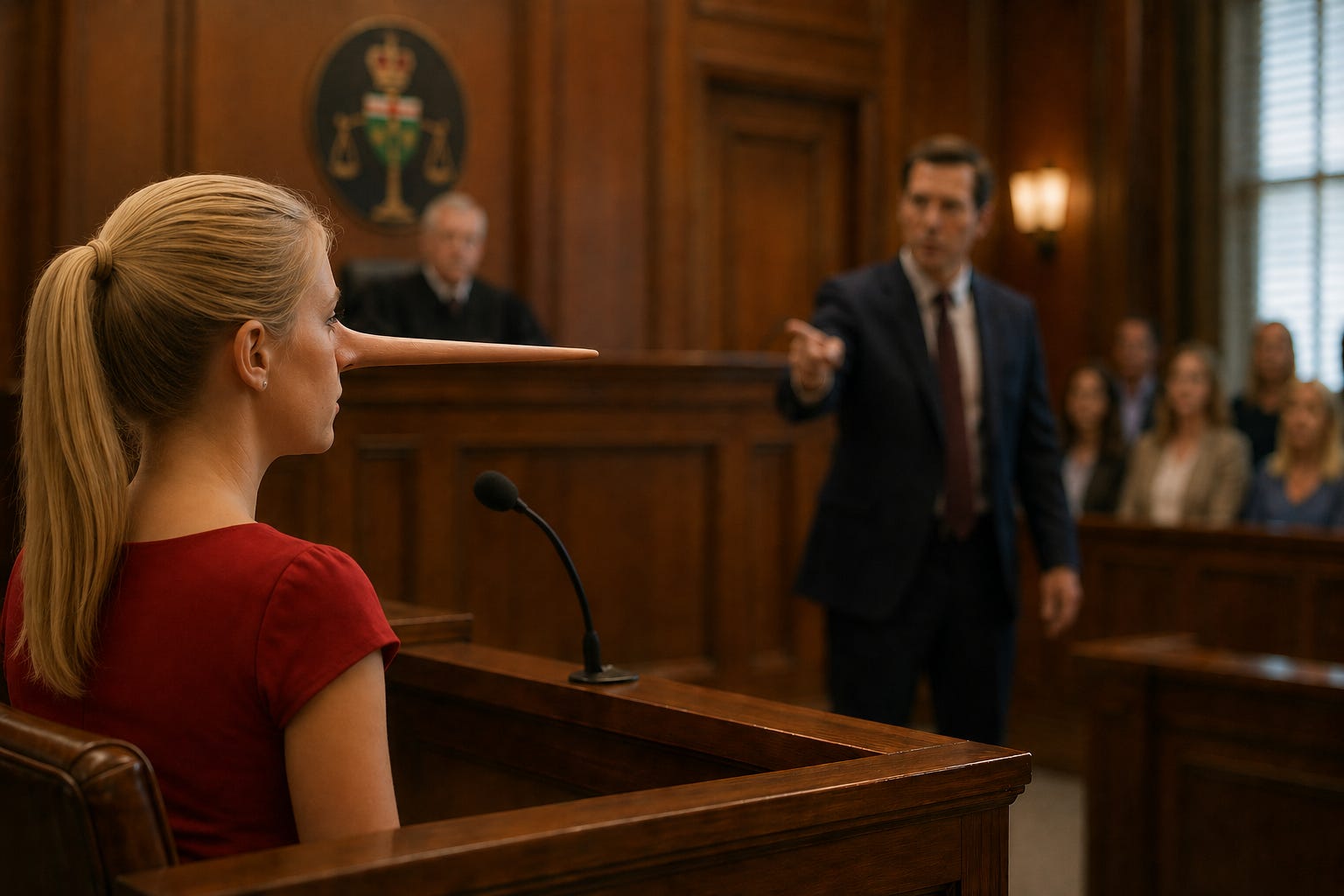
Credibility runs through everything I do as a mediator. It runs through every brief I read, every opening I hear, and every number that ultimately lands on the table. It is not a side issue. It is not something that gets sorted out neatly at trial while the rest of the case proceeds on clean legal principles. It is the case. And nowhere is that more obvious than in the determination of fault.
We tend to think of liability as an objective exercise. Who did what, when and where did they do it, how and why did they do it? But in practice, especially in personal injury litigation, those findings are filtered through human evidence, through witnesses who remember imperfectly, who reconstruct events, who sometimes exaggerate, and occasionally mislead. Judges do not decide fault in a vacuum. They decide it through people. And that means credibility is often the decisive factor in determining who caused what.
The Myth of Purely Objective Fault
On paper, negligence law looks straightforward. A plaintiff must establish that a defendant owed them a duty of care, that they breached that duty, that the breach caused them damage, and what those damages are. But once you move beyond the pleadings and into the evidence, things become far less tidy.
Take a typical motor vehicle accident. Two drivers, two versions of events. One says the light was green. The other says it was red. There may be no independent witnesses, no video, no objective data. I couldn’t count the number of times I have encountered this scenario. The entire liability determination may turn on whose evidence is accepted.
That is not a failure of the system. It is the system.
Canadian courts have long recognized that credibility is not determined by demeanour alone. In the 1951 decision Faryna v. Chorny[1], cited frequently since then across Canada including in Ontario, the BC Court of Appeal rejected uncontradicted evidence from a witness whose account, that he did not understand a common term in his own language or recognize the person being referred to, was inconsistent with the surrounding circumstances. The Court held that such evidence need not be accepted simply because it appears sincere, emphasizing that credibility must be tested against “the preponderance of the probabilities” and the realities of everyday life.
Judges therefore assess credibility not by appearance alone, but by whether a witness’s account makes sense in the context of the evidence as a whole.
Credibility as the Engine of Liability Findings
Once you accept that credibility is central, the rest follows.
If a judge accepts one party’s evidence over another’s, that finding does more than resolve a factual dispute. It can drive the entire liability analysis. It determines whether a duty was breached, whether conduct was reasonable, and ultimately who is at fault.
In my experience, this is particularly evident in cases involving conflicting accounts of conduct in slip and falls, intersection collisions, or incidents involving alleged sudden movements or unexpected hazards. In those cases, the law does not change. The standard of care remains the same. What changes is whose version of the facts is accepted.
And that acceptance is rooted in credibility.
Contributory Negligence: Where Credibility Splits the Difference
Credibility becomes even more important when courts are asked to apportion fault.
Contributory negligence is, at its core, an exercise in comparative responsibility. But that comparison depends on findings of fact. If a plaintiff’s evidence about their own conduct is rejected or only partially accepted, that can dramatically increase their share of fault.
A plaintiff who insists they were paying full attention but is contradicted by surrounding evidence may find themselves assigned a significant portion of liability. Not because the legal standard changed, but because their credibility did not hold.
This is where cases often turn in our mediations. Not on abstract principles, but on whether the plaintiff’s account of how the incident unfolded is believable.
When Credibility Collapses, So Does the Case
There is a harder edge to this.
Courts have long recognized that credibility findings can have broader consequences across a witness’s evidence. While there is no rigid rule that dishonesty on one point automatically invalidates all testimony, a finding that a witness is unreliable or untruthful on a material issue permits the trier of fact to approach the balance of that evidence with caution and to assign it reduced or even no weight where the surrounding circumstances do not support it. In civil cases, a judge is entitled to accept some, all, or none of a witness’s evidence, but once credibility is meaningfully undermined, confidence in the remainder of that evidence often erodes with it.
The law stops short of saying that disbelief on one issue requires rejection of everything. But in practice, the effect can be much the same. A witness who is found to have exaggerated, evaded, or been untruthful on a material point places their entire account at risk.
And that is where cases are won and lost. Once credibility is lost, it is rarely recovered.
The Reliable Narrator
I would be remiss in writing about credibility without referencing the work of The Honourable Todd L. Archibald, whose book Litigation and Administrative Advocacy: The Art and Science of Persuasion[2] has, in my view, captured something essential about how judges actually assess evidence.
I have written about this at length in my Substack, Dispatches from the Middle[3], including my review of His Honour’s Chapter 6 titled “The Reliable Narrator: Advocating with Persuasive Authority”[4]. That chapter co-authored with Mark Friedman, and frankly the entire book, has become, in my view, required reading for any serious advocate.
The central idea is deceptively simple, and profoundly important: the advocate must become a reliable narrator.
Borrowed from literature, the concept is this. Just as a reader instinctively trusts a narrator who presents facts honestly, consistently, and without exaggeration, a judge does the same with counsel and, by extension, with the evidence they advance. The persuasive advocate is not the loudest, or the most aggressive, or even the most technically clever. It is the one the decision-maker trusts.
That trust is not built through performance. It is built through restraint.
The reliable narrator does not overstate the case. They do not hide bad facts. They do not stretch evidence beyond what it can reasonably bear. They confront weaknesses early, concede what must be conceded, and allow the strength of the case to emerge from the facts themselves. As Archibald and Friedman make clear, once credibility is lost, persuasion does not just weaken. It collapses.
This is not confined to advocacy. It carries directly into the judicial assessment of liability.
A witness who presents as a reliable narrator that is measured, consistent, and aligned with the surrounding probabilities, will often be accepted even in the face of conflicting evidence. Conversely, a witness who exaggerates, evades, or appears to shape their evidence to fit a desired outcome risks losing the Court entirely. And once that happens, the legal analysis that follows is built on a very different factual foundation.
In that sense, the concept of the reliable narrator explains something that every litigator eventually learns the hard way. Credibility is not just about being believed on one point. It is about establishing a platform from which everything else can be accepted.
Or rejected.
Juries and Credibility: The Common-Sense Core
Juries bring this into even sharper focus.
Trial judges routinely instruct juries that they are the sole judges of credibility. They are told they may accept all, part, or none of a witness’s evidence. They are also told to consider consistency, plausibility, and whether the evidence aligns with common sense and the surrounding facts.
While the exact wording varies, the core message is consistent: if a jury finds that a witness has deliberately lied about a material matter, they are entitled to view the rest of that witness’s evidence with skepticism. That is not a technical legal rule. It is a reflection of ordinary human reasoning.
And it has real consequences. In a jury trial, credibility assessments are often more intuitive, less explained, and potentially more unforgiving. That uncertainty is something every litigator, and from my seat every mediator, has to account for.
The Coming Shift: Credibility in a Reformed System
The upcoming civil justice reforms in Ontario introduce a new layer to this discussion.
With a move toward more front-loaded evidence and a narrowing of oral examinations for discovery, the traditional tools for testing credibility are being reshaped. Discovery has long served as a pressure point, a place where inconsistencies are exposed, positions are tested, and the groundwork for impeachment is laid.
If that process is curtailed or streamlined, the ability to probe credibility before trial may be reduced. I see that this has two potential consequences.
First, parties may enter mediation with less clarity about how a witness will perform under scrutiny. The uncertainty increases, and with it, the range of reasonable outcomes.
Second, the trial itself may become a more concentrated battleground for credibility. If fewer inconsistencies are flushed out in advance, the impact of live testimony may be magnified.
Whether that improves the system or introduces new risks remains to be seen. But it will undoubtedly change how credibility is developed, tested, and leveraged.
Pulling It Together in Mediation
This is where it all comes home.
In mediation, credibility is rarely decided outright, but it is constantly assessed. Counsel know the strengths and weaknesses of their witnesses. Adjusters factor credibility risk into their reserves. Plaintiffs and defendants alike carry their own sense of how they will be perceived.
My role is not to determine who is telling the truth. But it is to understand how a judge or jury might view the evidence and to help the parties see that risk clearly.
A case that looks strong on paper can unravel if credibility is vulnerable. A case with factual gaps can gain traction if the key witness is persuasive and consistent. And in many cases, the ultimate settlement range is driven less by legal doctrine than by how the parties and their counsel assess the credibility landscape.
That is the reality of civil litigation.
Fault is not decided in the abstract. It is decided through people. And once you understand that, you begin to see the case for what it really is.
[1] 1951 CanLII 252 (BC CA). Online: https://www.canlii.org/en/bc/bcca/doc/1951/1951canlii252/1951canlii252.html
[2] Todd L. Archibald, Litigation and Administrative Advocacy: The Art and Science of Persuasion (Toronto: Irwin Law, 2023). Online: https://store.lexisnexis.com/en-ca/products/litigation-and-administrative-advocacy-the-art-and-science-of-persuasion.html
[3] https://substack.com/@shawnpatey
